The Industrial Floor Leader For The Future
" Give our customers satisfaction striving for excellence in the construction industry, working integrated with the latest technology and the most modern tools "
" Give our customers satisfaction striving for excellence in the construction industry, working integrated with the latest technology and the most modern tools "

Concrete pouring is a crucial step in construction, but often problems arise with uneven floors, resulting in substandard work that requires correction. This not only wastes time but also incurs additional costs. The laser screed method has become a modern technology that effectively solves this problem while creating surfaces that are smooth and meet international standards.
Using laser screed technology or Laser Screed helps control the level of concrete floor smoothness with precision. It's suitable for large areas such as factories, warehouses, and distribution centers that require high smooth floor standards. Today we will learn how to solve the problem of uneven concrete pouring with this modern technology.

- Concrete floors that turn out uneven result from several causes. The main causes commonly found are substandard concrete mixing, use of inadequate or improperly installed formwork, and the skill level of workers performing the task.
- Incorrect concrete mixing is a significant cause. If there's too much water, the concrete will segregate and create wrinkles. If there's too little water, the concrete becomes too thick and cannot flow smoothly according to the formwork. Additionally, not properly leveling the base before pouring is another contributing factor.
- The quality of formwork and installation affects floor smoothness. If the formwork warps or isn't strong enough, it will result in an uneven concrete surface. Improper placement of reinforcement steel can also cause floor irregularities.
- Traditional surface screeding methods using hands or wooden boards often cannot control levels with precision, especially in large areas. These errors accumulate until the final floor doesn't meet the required standards. These problems will impact future use, such as machine installation, goods movement, or improper drainage.
- Weather conditions during concrete pouring are also important. If the weather is hot and windy, water in the concrete will evaporate too quickly, causing uneven surface drying and surface cracking. Not properly curing concrete after pouring is another cause that reduces floor quality.
Concrete floors that are smooth are not just about aesthetics but are extremely important for actual use, especially in industrial and commercial applications that require surfaces to support weight and traffic of vehicles and heavy machinery. For industrial factories, smooth surfaces help reduce machine vibrations, making production more efficient and reducing equipment wear. They also make maintenance and cleaning easier because there are no grooves or accumulation points for dirt. In warehouses and distribution centers, smooth floors enable smooth movement of goods with forklifts and internal transport vehicles, reducing vibrations that might damage goods and increasing workplace safety.
Furthermore, drainage is another important issue. Uneven surfaces cause water to pool in various spots, creating humidity problems, decay, and potential breeding grounds for germs. Smooth floors with properly designed slopes help water flow out efficiently. In terms of safety, uneven floors cause workplace accidents such as tripping, falling, or vehicle rollovers. Smooth floors help reduce these risks and make the work environment safer. They also help reduce long-term repair and maintenance costs.

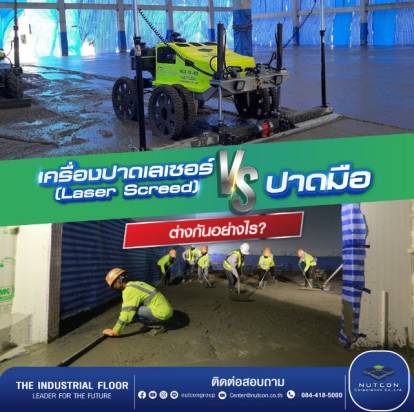
Laser screed or Laser Screed is technology that uses laser light to control the level of concrete floor screeding to achieve the specified smoothness. This system consists of a laser signal transmitter that creates a reference light level and a screed machine equipped with laser signal receiving sensors.
The operation of the laser screed system begins with installing the laser signal transmitter in an appropriate position, creating a precise laser light plane. The screed machine then moves across the concrete pouring area, with sensors receiving signals from the laser light and automatically adjusting the screed plate level to match the specified level.
Types of popular laser screed include 2 main types: Laser Boom Screed which has arms extending from the machine body, suitable for wide areas without obstacles, and Laser Truss Screed with beam-like structure, suitable for road work or long linear areas.
Advantages of laser screed technology include very high precision, capable of controlling levels to the millimeter. Work speed is much faster than traditional methods, capable of screeding hundreds of square meters per hour, and reducing labor use by up to 60% compared to traditional screeding methods.
The laser screed system can also work well in areas with reinforcement steel or obstacles because it can adjust levels precisely and avoid collisions with various obstructions. It also helps concrete achieve more uniform density through precisely controlled screeding processes.

Using laser screed technology has several advantages over traditional methods. The first advantage is precision in level control. Traditional methods using wooden boards or hand tools depend on worker skills and can easily result in errors. Work speed is another important advantage. Laser screed can work 4-5 times faster than traditional methods, allowing projects to be completed more quickly and reducing time and labor costs. Reducing labor use by up to 60% not only saves labor costs but also reduces risk of human error.
The quality of concrete floors achieved with laser screed is more uniform and smooth because machinery can control pressure and screeding speed consistently, resulting in surfaces with uniform density and strength throughout the area. Overall cost savings is an important advantage. Although laser screed machine rental costs are higher than traditional tools, when considering combined labor costs, work time, and work quality, savings of approximately 30-50% of overall costs can be achieved.
Laser screed also helps reduce risk of work corrections because high precision reduces chances of errors, eliminating time and costs for repairs or redoing work. It can also work in various environments, whether narrow or wide areas, with or without obstacles. Another advantage is reduced environmental impact because highly efficient work reduces fuel use and pollution emissions. Appropriate use of concrete without waste also helps reduce material loss.
Comparing costs between laser screed and traditional methods requires considering several factors including equipment rental costs, labor costs, work time, and quality of results achieved.
- In terms of laser screed machine rental costs, prices are higher than traditional tools, on average perhaps 3-4 times higher. However, when considering work efficiency, laser screed can work 4-5 times faster, significantly reducing rental time.
- Labor costs are where the most savings can be achieved. Using laser screed helps reduce labor use by up to 60% because fewer workers are needed, and specialized skilled workers aren't required as much as with traditional methods, resulting in clearly reduced overall labor costs.
- Faster work time affects overall project costs because work can be delivered more quickly, reducing project management expenses and opening opportunities to take on new jobs faster. Faster project completion also helps reduce risks from external factors such as weather.
- Quality of concrete floors achieved with laser screed has higher standards, resulting in longer service life and reduced future maintenance costs. Floors meeting smoothness standards also make equipment or machinery installation on floors easier and more precise.
When calculating long-term ROI (Return on Investment), using laser screed proves more cost-effective, especially for large projects requiring high standards. Overall cost savings may be 30-50% compared to traditional methods.
Conclusion
Solving uneven concrete pouring problems with laser screed technology is a highly effective option for modern construction work. With precision, speed, and quality superior to traditional methods, it has become popular for large projects, especially factories, warehouses, and commercial areas requiring high smooth floor standards.
Although initial investment is higher, long-term benefits in terms of quality, durability, and maintenance cost savings make laser screed a worthwhile technology for investment. Choosing to use this technology is therefore a smart decision for those who want high-quality concrete floors with maximum efficiency.